Aluminum Mold vs Steel Mold | Cost, Lifetime & Performance Comparison
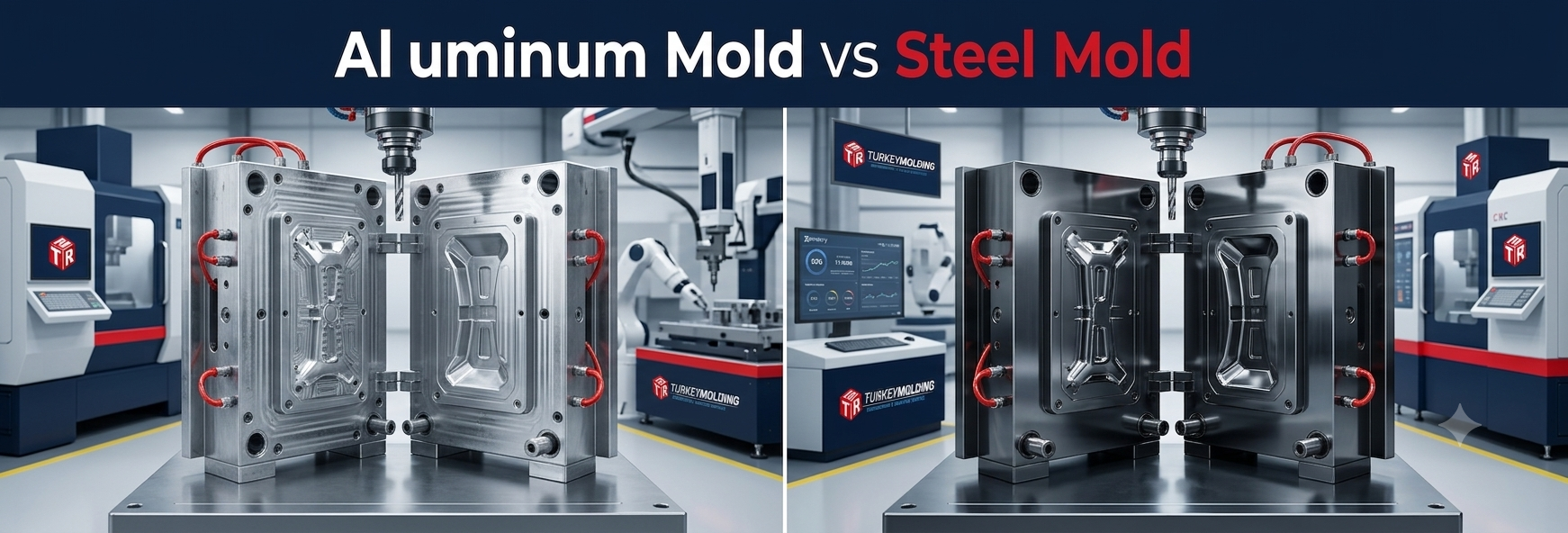
Aluminum Mold vs Steel Mold | Cost, Lifetime & Performance Comparison
When launching a new plastic injection molding project, one of the most critical decisions engineers and procurement managers must make is selecting the correct tooling material. The choice between an aluminum mold and a steel mold fundamentally shapes your upfront capital expenditure, production cycle efficiency, and long-term piece price.
There is no one-size-fits-all answer; the optimal material depends entirely on your production volume, time-to-market constraints, and component requirements. This comprehensive guide details the key differences between aluminum and steel tooling in 2026, helping you maximize ROI for your manufacturing pipeline.
Why Mold Material Matters
The chemical and physical properties of your tool block directly affect every step of the manufacturing lifecycle. Your choice of mold material determines:
- Initial Investment Cost: Tooling represents a major fixed asset cost. Aluminum significantly lowers the financial barrier to entry, while steel demands a larger upfront budget.
- Production Speed (Cycle Time): The thermal conductivity of the mold material governs how fast heat can be pulled out of the molten plastic. Faster cooling means shorter cycle times and higher daily output.
- Mold Lifetime: High-pressure injection cycles cause wear and erosion. Harder materials withstand abrasive resins and clamping forces far longer before requiring replacement or rework.
- Maintenance & Repair Costs: Molds require regular cleaning, parting-line adjustments, and lubrication. Aluminum is softer and more vulnerable to damage, while hardened steel resists scratches and parting-line wear but requires more specialized laser welding if a repair is needed.
- Part Quality & Consistency: Tool deflection under intense clamping forces can cause flash or dimensional drift. Rigid materials ensure tight tolerances across millions of identical shots.
What Is an Aluminum Mold?
Modern aluminum molds do not use standard structural aluminum; they are engineered from specialized, high-density aerospace alloys like QC-10 or 7075-T6. These alloys bridge the gap between traditional metals, offering remarkable strength paired with excellent thermal traits.
Core Advantages
- Significantly Lower Cost: Aluminum blocks are less expensive, and because the metal is softer, CNC milling machines can cut pockets, runners, and cooling channels up to three times faster than in steel, drastically reducing toolroom labor costs.
- Accelerated Lead Times: Shorter machining times mean your tool shifts from a 3D CAD design to a functional testing press in a fraction of the time.
- Superior Thermal Conductivity: Aluminum dissipates heat roughly four times faster than standard tool steels. This rapid cooling can shave 20% to 50% off cycle times, enabling faster production runs even on smaller machinery.
Primary Applications
- Prototype Tooling: Creating functional, identical parts in final production plastics for field testing, regulatory approvals, and mechanical verification.
- Low-Volume Manufacturing: Ideal for bridging production gaps, niche market consumer products, and specialized industrial components where total lifetime demand stays below 50,000 units.
- Market Validation Validation: Rolling out a limited batch of products to gauge consumer interest and retail performance before freezing final designs for mass production.
What Is a Steel Mold?
Steel molds are the undisputed workhorses of global mass production. Toolmakers utilize various grades of steel depending on the application, ranging from pre-hardened alloys like P20 and NAK80 to ultra-hardened premium tool steels like H13 and S7.
Core Advantages
- Exceptional Longevity: Hardened steel tools withstand abrasive, glass-filled resins, high injection pressures, and harsh clamping cycles for decades without losing dimensional accuracy.
- High Precision & Complex Geometries: Steel holds razor-sharp edges and intricate details perfectly. It is highly resistant to tool deflection, allowing engineers to deploy complex hydraulic sliders, lifters, and unscrewing mechanisms without risking premature mechanical failure.
- Optimized Surface Finishes: If your part demands an optically clear lens finish (SPI A-1 mirror polish) or an aggressive textured pattern, steel is robust enough to accept and retain these surface treatments across millions of cycles.
Primary Applications
- High-Volume Mass Production: Essential for large-scale operations where a single tool must continuously spit out millions of components.
- Automotive Sourcing: Interior panels, engine brackets, and lighting housings that must comply with strict structural safety tolerances.
- Medical & Pharmaceutical: Multi-cavity cleanroom molds for syringes, fluid ports, and surgical device housings requiring extreme precision.
- Home Appliances (White Goods): Large, structural housings for washing machines, dishwashers, and consumer electronics.
Technical & Cost Comparison
Evaluating the operational and financial differences between these two tooling options highlights the clear trade-offs across key project metrics:
| Feature / Metric | Aluminum Molds (QC-10 / 7075) | Steel Molds (P20 / H13) |
|---|---|---|
| Initial Tooling Cost | Lower (Typically 30% - 50% less) | Higher (Requires heavier investment) |
| Lead Time | Faster (2 to 4 weeks) | Longer (4 to 12+ weeks) |
| Thermal Cooling Rate | Excellent (Fast cycles, low energy) | Standard (Requires extensive cooling lines) |
| Modification Flexibility | High (Easy to re-machine or alter) | Low (Requires EDM or specialized welding) |
| Wear & Abrasion Resistance | Limited (Can be worn down by glass fibers) | Extreme (Resists high structural wear) |
Lifetime Comparison by Material Grade
A mold's lifespan is directly dictated by its rockwell hardness ($HRC$) and structural composition. The following table highlights the typical life expectancy (measured in press cycles or "shots") you can expect across different tooling grades:
| Tooling Class & Material Grade | Expected Mold Life (Shots) | Best Suited For |
|---|---|---|
| Aircraft-Grade Aluminum | 5,000 – 100,000 | Prototypes, market testing, and short-run production. |
| P20 Pre-Hardened Steel | 100,000 – 500,000 | Mid-volume manufacturing and non-abrasive resins. |
| H13 / Premium Hardened Steel | 500,000 – 2,000,000+ | Long-term high-speed automation and mass production. |
Lead Time Breakdown
Time-to-market can make or break a product launch. Sourcing aluminum molds allows you to cut your development timeline significantly:
- Aluminum Molds: 2 to 4 Weeks. Fast setup, rapid machining feeds, and minimal post-processing oven heat-treatments mean the tool can be assembled and trialed rapidly.
- Steel Molds: 4 to 12 Weeks. Machining hardened steel requires slow CNC passes to protect cutting inserts. Multi-cavity tools also require extensive wire EDM processing, custom slide fitting, and multi-stage thermal hardening treatments to reach final structural hardness.
Production Volume Selection Guide
To streamline your strategic sourcing pipeline, use this checklist to align your project goals with the correct tooling material:
Choose an Aluminum Mold If:
- ✓ You need to complete initial prototype validation or clear regulatory hurdles quickly.
- ✓ Your total projected lifecycle volume for the part does not exceed 50,000 to 100,000 units.
- ✓ You are dealing with tight deadlines and must launch your product to market immediately.
- ✓ The component design is likely to evolve based on real-world consumer feedback.
Choose a Steel Mold If:
- ✓ You are entering permanent mass production with long-term forecasts exceeding hundreds of thousands of units.
- ✓ The plastic resin contains high concentrations of glass fibers, carbon fibers, or flame-retardant additives that erode softer metals.
- ✓ The part features highly complex internal mechanisms, deep vertical walls, or requires an ultra-tight tolerance matrix.
- ✓ Your application falls within strict automotive, aerospace, or medical supply chains.
When Does Aluminum Become More Expensive?
While aluminum has a compelling, low initial cost, it can become a financial trap if misapplied to high-volume pipelines. This phenomenon is known as the Tooling Cost Inflection Point.
[Low Volume]  Aluminum Total Cost  <  Steel Total Cost  (Savings on Tooling)
[High Volume] Aluminum Total Cost  >  Steel Total Cost  (Cost of Re-tooling & Scrap)
If your product demand outpaces expectations and you try to push an aluminum mold past its rated lifespan, the tool will begin to degrade. The parting lines wear down, causing severe plastic flash (excess plastic bleeding out of the part boundaries), guide pins lose alignment, and core surfaces can scratch.
To maintain production, you will face two hidden costs:
- Elevated Scrap Rates: Defective, out-of-tolerance parts increase your material waste and quality control inspection overhead.
- The Cost of Re-Tooling: If an aluminum mold fails at 80,000 shots and you need to produce 300,000 parts, you will have to pay for a second or third aluminum tool. At that point, the cumulative cost of multiple aluminum molds far exceeds the cost of purchasing a single, highly durable H13 steel tool right from the start.
TurkeyMolding Tooling Selection Matrix
To help you balance risk and optimize capital expenditure, TurkeyMolding relies on a standardized selection framework to pair your production forecasts with the correct tooling configuration:
| Total Production Volume | Recommended Tooling Material | Engineering Configuration Strategy |
|---|---|---|
| 1 – 10,000 units | Aluminum (QC-10) | Single-cavity open/close tool maximized for fast delivery and low upfront cost. |
| 10,000 – 100,000 units | Project-Based Evaluation | High-grade coated aluminum or pre-hardened P20 steel steel, depending on resin abrasiveness. |
| 100,000+ units | Steel (P20 / H13) | Multi-cavity hardened tool steel with optimized cooling channels for minimum piece price. |
How TurkeyMolding Optimizes Your Sourcing Project
Sourcing injection molding tooling internationally can be complex. TurkeyMolding operates as your direct engineering partner on the ground in Turkey, bridging the gap between design and production:
- Expert Supplier Matching: We align your project with audited, ISO-certified Turkish mold-making facilities that possess deep technical expertise in your specific industry.
- Rigorous Design for Manufacturability (DFM) Review: Our engineering team analyzes your 3D models before any metal is cut. We identify potential draft angle issues, non-uniform walls, and gate locations to ensure your design runs smoothly in either aluminum or steel.
- Transparent Tooling Quotations: Receive completely itemized quotes breaking down steel grades, cavity options, cycle-time estimates, and guaranteed tool lifespans.
- End-to-End Manufacturing Support: We manage the entire project lifecycle—from rough milling through T1 sampling and final dimensional inspection logs—ensuring your tools are delivered on time and on budget.
Request Your Custom Mold Quote
Ready to optimize your production workflow, minimize initial tooling risks, and leverage Turkey's elite manufacturing infrastructure? Let TurkeyMolding handle the heavy lifting.
Contact our application engineering team today to submit your 3D CAD models (STEP, IGES, or X_T). We will deliver a comprehensive DFM manufacturability assessment and a competitive, transparent tooling quotation.
[Get a Free Injection Mold Quote Now]