CNC Machining vs Casting | Cost, Precision & Production Comparison (2026)
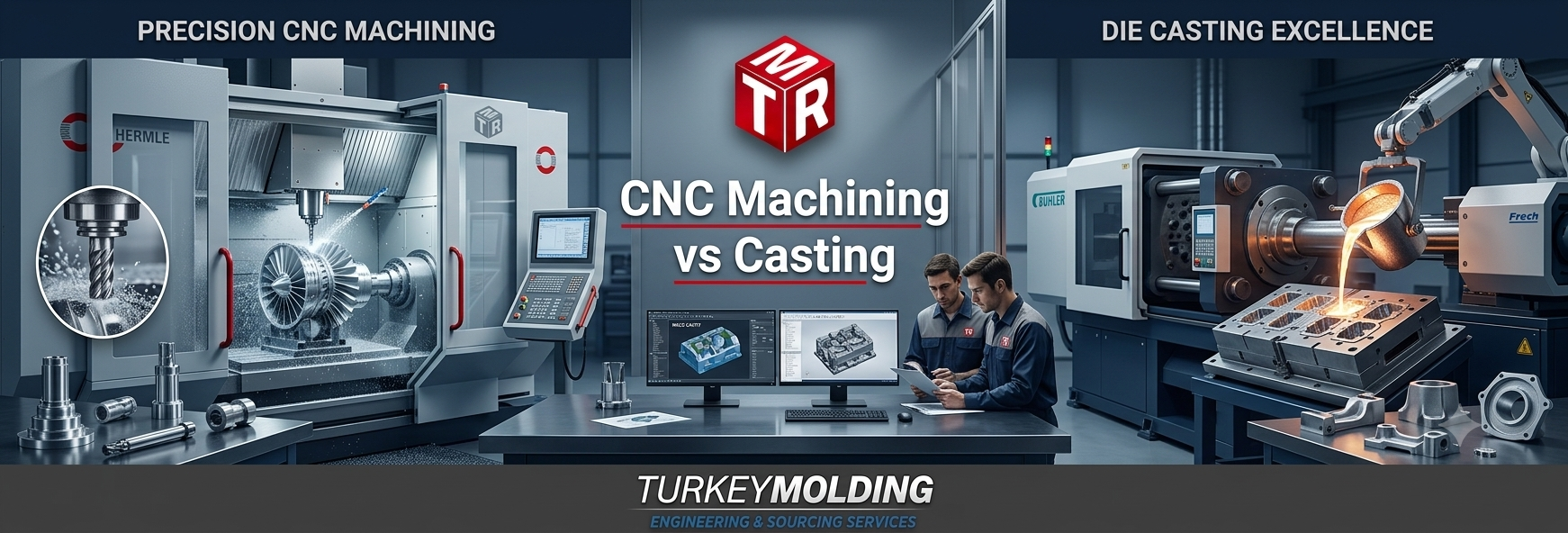
CNC Machining vs Casting | Cost, Precision & Production Comparison (2026)
When engineering a new component or scaling an existing product line, selecting the optimal manufacturing architecture is one of the most critical decisions for purchasing managers, mechanical design engineers, and product development teams. The debate typically centers around two foundational approaches to shaping metal: CNC Machining (Subtractive Manufacturing) and Casting (Formative Manufacturing).
Choosing the wrong process can lead to budget overruns, missed product launches, or component failures in critical fields like automotive, aerospace, medical devices, and industrial machinery. This 2026 technical guide provides a rigorous engineering comparison of CNC machining vs casting across precision, cost curves, tolerances, material catalogs, and production volume break-even thresholds to optimize your strategic sourcing workflow.
What is CNC Machining?
Computer Numerical Control (CNC) machining is a subtractive manufacturing process. It begins with a solid block, bar, or billet of raw material (metal or plastic), and utilizes high-speed, automated cutting tools to systematically shave away material until the desired final three-dimensional geometry is achieved.
Core Technical Modalities
- CNC Milling: The raw material remains stationary or secured in a vise while rotary cutting tools move across multiple axes ($X, Y,$ and $Z$) to carve out pockets, slots, flat surfaces, and complex profiles.
- CNC Turning: The workpiece is clamped in a chuck and spun at high RPMs while a stationary cutting tool shears material away. This is the ideal approach for concentric, cylindrical, or axisymmetric custom metal parts.
- 5-Axis Machining: Advanced machining centers that simultaneously rotate and move cutting tools along five different axes. This capability eliminates multiple setups, allowing toolheads to reach deep inside intricate pockets and compound angles efficiently.
- Precision Machining: The integration of rigid machine beds, thermal compensation software, and high-end tool carousels to achieve tight dimensional metrics and highly precise finishes consistently.
Key Engineering Advantages
- Ultra-Tight Tolerances: Consistently hits tight tolerances down to $\pm0.01\text{ mm}$.
- Exceptional Precision & Repeatability: Eliminates human error completely, delivering near-identical dimensional consistency across consecutive part setups.
- Unmatched Geometrical Freedom: Sharp internal walls, deep square pockets, and complex external threads are easily cut from standard CAD models.
- Rapid Prototyping Pipeline: Requires zero physical tooling or patterns. Production can begin immediately after locking in your digital STEP/IGES design files.
What is Casting?
Casting is a formative manufacturing process where raw metal is heated past its melting point into a fully liquid state. This molten metal is poured or injected under intense pressure into a custom-engineered mold cavity (known as tooling or a die) that mirrors the external and internal features of the target part. Once the thermal energy dissipates and the metal solidifies, the part is removed from the mold for clean-up and final processing.
Core Technical Modalities
- Sand Casting: Molten metal is poured into a single-use mold formed from compressed, resin-bonded sand. This is the industry standard for exceptionally massive structural cast parts, though it yields a coarser surface finish.
- Die Casting: Liquid metal (typically aluminum, zinc, or magnesium) is injected under extreme hydraulic pressure into reusable hardened steel dies. This methodology delivers excellent dimensional repeatability and smooth finishes at rapid cycle speeds.
- Investment Casting (Lost Wax): A sacrificial wax pattern is dipped into a ceramic slurry to form a seamless shell. The wax is melted out, and molten metal is poured into the hollow ceramic cavity, producing complex casting geometries with superior detail.
- Gravity Casting (Permanent Mold): Molten alloy is poured directly into a reusable steel or iron mold using only the natural pull of gravity. This method provides better structural density and mechanical properties than sand casting.
Key Engineering Advantages
- Optimized for Massive Parts: Capable of forming massive structural frames, engine blocks, and heavy industrial housings weighing up to several tons.
- Rock-Bottom High-Volume Unit Costs: The variable cost per piece drops down significantly once the upfront metal die investment is fully amortized.
- High Scale Production Output: Reusable steel dies can process thousands of complex parts weekly with highly automated extraction lines.
- Complex Internal Cavities: Specialized sand or ceramic cores can be suspended inside the mold to cast complex, hollow internal chambers that are physically inaccessible to standard CNC cutting tools.
Feature-by-Feature Comparison Matrix
Understanding the fundamental operational and material trade-offs is essential for aligning your design parameters with the correct production method:
| Technical Feature | CNC Machining (Subtractive) | Casting (Formative) |
|---|---|---|
| Precision & Tolerances | Excellent ($\pm0.01\text{ mm}$) | Good ($\pm0.10\text{ mm}$ to $\pm0.50\text{ mm}$) |
| Surface Finish ($Ra$) | Excellent ($0.8\ \mu\text{m} - 3.2\ \mu\text{m}$ out of machine) | Medium ($3.2\ \mu\text{m} - 12.5\ \mu\text{m}$ raw cast) |
| Initial Tooling Investment | Low / None (Only fixture and setup fees) | High (Upfront costs for custom steel dies) |
| Variable Unit Cost | Higher (Due to machine time & material waste) | Lower at Scale (Highly economical at high volume) |
| Production Lead Time | Fast (Typically 1 to 3 weeks) | Medium (4 to 12 weeks for tooling fabrication) |
| Raw Material Waste | High (Shaves away significant billet volume) | Very Low (Sprues & runners are remelted) |
| Design Change Flexibility | Easy (Simple, low-cost digital CAD updates) | Difficult (Requires expensive mold modifications) |
Production Volume & Cost Curve Dynamics
The financial choice between CNC machining and casting is heavily dictated by your total projected batch quantity over the product lifecycle.
[Low Volume: 1-500 parts]      -->  CNC Machining Wins (Zero Upfront Tooling Risk)
[High Volume: 10,000+ parts]   -->  Casting Wins (Tooling Amortized, Ultra-Low Piece Price)
1. Prototype Phase (1 – 10 Parts)
CNC Machining wins definitively. Paying $15,000 for a permanent die casting tool to validate a handful of testing units is cost-prohibitive. CNC allows you to jump straight into production using standard stock blocks.
2. Small Batch Run (10 – 500 Parts)
CNC Machining remains highly advantageous. The cumulative cost of raw machine time and setup labor is still lower than the capital investment needed to engineer, machine, heat-treat, and validate a custom metal casting die.
3. Medium Volume Production (500 – 2,000 Parts)
The Inflection Threshold. This is a project-dependent transition zone where the geometry determines the best approach. For highly complex parts requiring substantial material removal, casting often becomes the more economical choice. For simpler geometries with minimal raw stock waste, high-speed multi-axis CNC cells can remain highly competitive.
4. Mass High Volume Scaling (10,000+ Parts)
Casting is significantly more economical. Once the initial die investment is made, the per-part cost drops down drastically. Running 10,000 identical components sequentially on a CNC line consumes considerable machine time, cutting tool inserts, and operator oversight, creating a steep cost curve that cannot compete with high-speed automated casting presses.
Material Compatibility Profiles
The choice of manufacturing process also determines the metallurgical properties, crystal structures, and material selections available for your component:
CNC Machining Materials
Subtractive setups work with cold-rolled, extruded, or forged billets, ensuring maximum density and eliminating internal voids:
- Aluminum Alloys: 6061-T6 (excellent machinability), 7075-T6 (aerospace-grade high-strength), 2024, and 5052.
- Stainless Steel: 304, 316L (marine/medical grade), and 17-4 PH.
- Alloy & Tool Steels: 4140, 4340, P20, and D2.
- Red Metals: Brass, Bronze, and pure Copper (excellent for electrical/thermal conductivity).
- Specialized Refractories: Titanium (Ti-6Al-4V) and Inconel.
- Engineering Polymers: POM (Delrin), Nylon 66, PEEK, and PTFE.
Casting Alloys
Formative setups require alloys with low melting points, high fluidity when molten, and minimal volumetric shrinkage during cooling:
- Aluminum Alloys: A380 (the die casting standard), A356 (excellent for structural integrity), and A360.
- Zinc Alloys: Zamak 3, Zamak 5 (ideal for thin-walled components and tight tolerances).
- Ferrous Metals: Gray Iron, Ductile Iron, Carbon Steel, and Stainless Steel grades.
- Specialized Alloys: Bronze, Brass, and lightweight Magnesium (AZ91D).
Tolerance & Surface Finish Breakdown
Precision Capabilities
- CNC Machining: Easily maintains a baseline tolerance profile of $\pm0.01\text{ mm}$. For specialized high-end aerospace fittings, it can tighten down to $\pm0.005\text{ mm}$.
- Die Casting: Delivers a reliable commercial precision rating of $\pm0.10\text{ mm}$.
- Sand Casting: Due to the shifting nature of compressed sand grains under intense thermal shock, tolerances expand to a broader baseline of $\pm0.50\text{ mm}$.
Surface Roughness ($Ra$) Performance
Surface roughness defines how a component seals, wears, and performs under mechanical stress.
- As-Machined CNC: Achieves a smooth surface roughness profile between $0.8\ \mu\text{m}$ to $3.2\ \mu\text{m}\ Ra$. Specialized micro-milling passes can lower this directly down to an ultra-smooth $0.4\ \mu\text{m}\ Ra$.
- As-Cast Die Tooling: Delivers a smooth, uniform surface between $1.6\ \mu\text{m}$ to $3.2\ \mu\text{m}\ Ra$, which easily accepts powder coating or anodization treatments.
- As-Cast Sand Molds: Yields a textured finish ranging from $6.3\ \mu\text{m}$ up to $25.0\ \mu\text{m}\ Ra$, which typically requires post-process shot blasting or abrasive grinding.
Strategic Sourcing Matrix
Use this quick checklist to guide your team's manufacturing path:
Choose CNC Machining If:
- ✓ You are validating early-stage prototypes or running initial field-test batches.
- ✓ Your total long-term volume remains below 1,000 to 2,000 total pieces.
- ✓ The part requires ultra-tight tolerances ($\pm0.01\text{ mm}$) for critical mechanical fits.
- ✓ The product is destined for strict, high-compliance environments like medical implants or aerospace structural kits.
Choose Casting If:
- ✓ You are launching large-scale commercial or retail production runs (>10,000 pieces).
- ✓ The component is exceptionally large or heavy, such as a major agricultural or construction structural frame.
- ✓ Your application is highly cost-sensitive and relies on maximizing volume to achieve low unit pricing.
- ✓ The part is a complex automotive component, engine block, or industrial machinery housing.
The Hybrid Manufacturing Strategy
Experienced engineering teams rarely look at these processes as mutually exclusive. Instead, they implement a hybrid manufacturing workflow to maximize the benefits of both technologies, lowering overall production costs while hitting strict engineering tolerances:
[Phase 1] Digital CAD Design Initialization
    ↓
[Phase 2] CNC Machining (Rapid Prototyping & Field Testing)
    ↓
[Phase 3] Design For Manufacturability (DFM) Core Analysis
    ↓
[Phase 4] Mass Production casting (forming the Near-Net Shape)
    ↓
[Phase 5] Post-Process CNC Machining (Finishing Critical Tolerances)
Step 1: Near-Net Shape Forming (Casting)
The raw casting process handles the bulk of the work. It rapidly shapes the raw metal alloy into a close approximation of the final part—known as a near-net shape—forming the core structural geometry, mounting brackets, and hollow internal cavities with minimal material waste.
Step 2: High-Precision Finalization (CNC Machining)
The raw cast component is transferred into a high-speed CNC machining cell. The CNC machine cuts only the critical features that require strict precision, such as milling perfectly flat sealing faces, boring out tight bearing seats ($\pm0.01\text{ mm}$), and tapping clean internal threads.
This hybrid workflow delivers the best of both worlds: the raw speed and low material waste of casting combined with the razor-sharp accuracy of precision machining.
Real-World Industry Case Studies
Automotive Powertrain Components
- The Component: Heavy-duty engine mounting bracket.
- The Strategy: The complex external brackets and structural ribbed walls are formed via high-pressure die casting. The part is then secured in a CNC jig where the bolt holes are drilled and the main face is milled flat to ensure a leak-proof seal against the engine block.
Medical Instrumentation
- The Component: Multi-channel fluid diagnostic surgical blocks.
- The Strategy: 100% CNC machined from solid 316L medical-grade stainless steel blocks. This approach guarantees zero internal porosity or microscopic air bubbles (which can trap bacteria in cast parts), while easily hitting the tight dimensional tolerances required for medical devices.
Aerospace Structural Fittings
- The Component: Jet engine actuation housing.
- The Strategy: The intricate, thin-walled housing is shaped through high-precision investment casting. A final 5-axis CNC machining pass then clears away gate remnants and refines the internal bore tolerances to ensure precise alignment under extreme flight stress.
Leverage the TurkeyMolding Global Manufacturing Network
Sourcing premium toolmaking, custom metal casting, and precision multi-axis CNC machining across international supply chains requires robust engineering oversight, clear technical validation, and consistent quality management. TurkeyMolding operates as your expert manufacturing partner on the ground in Turkey, streamlining your procurement lifecycle from prototype to mass production:
- Precision CNC Machining services: High-speed 3-axis, 4-axis, and 5-axis milling and turning centers capable of hitting tight industrial tolerances down to $\pm0.01\text{ mm}$.
- Advanced Die Casting Infrastructure: Automated aluminum, zinc, and magnesium die casting lines equipped for high-volume automotive and consumer electronics projects.
- Heavy-Duty Sand & Gravity Casting: Foundries geared for massive structural gray iron, ductile iron, and aluminum components.
- Rigorous Design for Manufacturability (DFM) Reviews: Our engineering team analyzes your STEP/IGES models to optimize draft angles, uniform wall thicknesses, and split lines before manufacturing begins.
- Comprehensive Quality Control & Inspection: Every production run undergoes complete coordination tracking, material certifications, and digital CMM dimensional reports to ensure strict compliance.
Request Your Manufacturing Quotation
Ready to minimize your upfront tooling risks, optimize your component unit economics, and tap into Turkey’s elite manufacturing ecosystem? Let TurkeyMolding manage the heavy lifting.
Contact our application engineering team today to submit your 3D CAD files. We will provide a thorough DFM manufacturability analysis alongside a competitive, transparent CNC machining or custom casting quotation.
[Get a Free CNC & Casting Quote Now]