Die Casting Mold Cost Guide 2026 | Aluminum & Zinc Tooling Prices
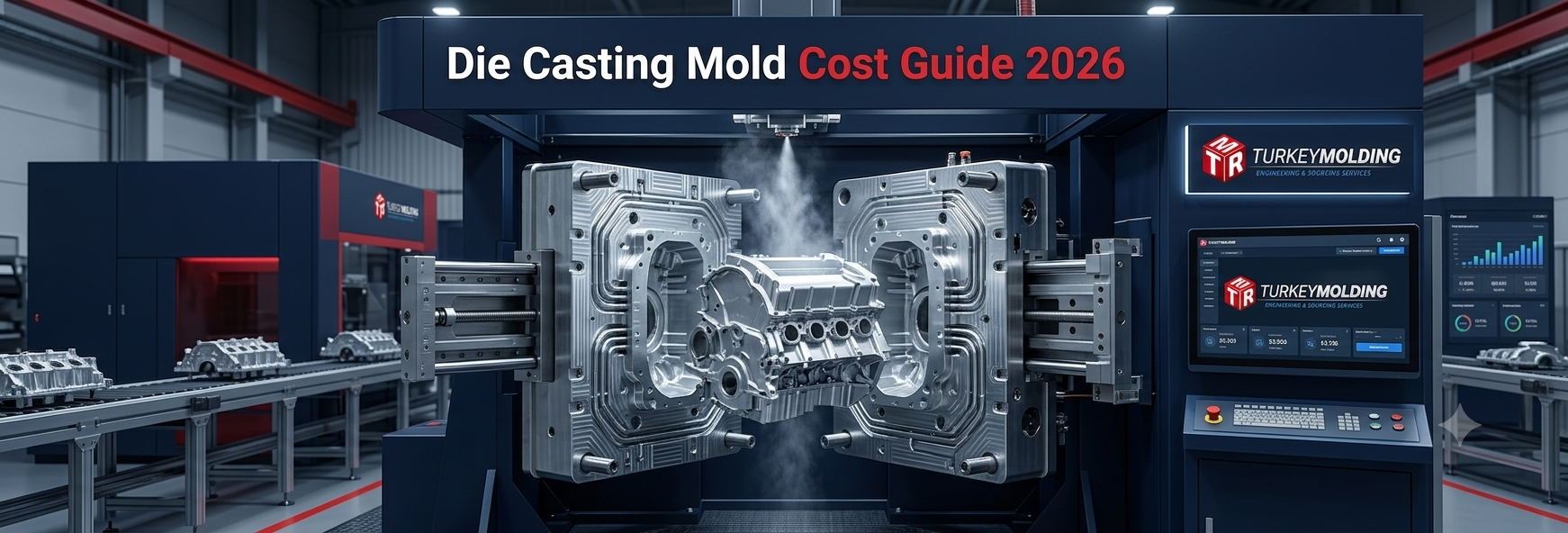
Die Casting Mold Cost Guide 2026 | Aluminum & Zinc Tooling Prices
For procurement managers, structural engineers, and product developers, selecting the right metal casting process is crucial to balancing high performance with strict budgetary targets. When it comes to producing robust, dimensionally stable, and complex metal parts at scale, die casting is the industrial standard.
However, high-pressure die casting demands a substantial initial capital expenditure for tooling. This comprehensive guide breaks down die casting mold costs in 2026, explains the core engineering variables driving these prices, evaluates mold lifespans, and explores why sourcing your tooling from Turkey offers a distinct strategic advantage.
What Is Die Casting?
Die casting is a manufacturing process where molten metal is injected under extreme pressure into a hardened steel mold cavity (known as a die). The metal solidifies rapidly under pressure, after which the mold opens to eject a highly accurate, repeatable, near-net-shape metal component.
Unlike gravity casting or sand casting, the high-pressure mechanism ensures crisp surface details, thin walls, and exceptional structural integrity.
High-Value Applications Across Demanding Sectors
Because of its unique ability to handle high stress and deliver premium structural qualities, die casting is widely utilized across several key sectors:
- Automotive Parts: Engine blocks, transmission cases, structural pillars, oil pans, and brackets.
- Motor Housings: Electric vehicle (EV) drive units, industrial electric motor frames, and alternator housings.
- Electronic Enclosures: EMI/RFI shielded telecommunication covers, 5G transceiver housings, and server chassis components.
- LED Lighting Bodies: Heavy-duty streetlamp fixtures, floodlight heat sinks, and industrial high-bay lighting housings.
- Industrial Equipment: Pneumatic valve bodies, pump impellers, hydraulic manifolds, and heavy machinery brackets.
- Defense & Aerospace Components: High-strength structural links, fuel system housings, and specialized instrumentation frames.
The Primary Types of Die Casting Methods
The thermodynamic properties and melting points of the alloy you choose dictate whether your project requires a hot-chamber or cold-chamber die casting setup, directly influencing mold engineering complexity:
1. Aluminum Die Casting
Aluminum alloys (such as A380, A383, or AlSi9Cu3) dominate the industry. Aluminum requires a cold-chamber process where molten metal is ladled into a shot sleeve before injection to protect machine components from high temperatures.
- Key Traits: Exceptionally lightweight, highly durable, excellent thermal and electrical conductivity, and high corrosion resistance. It is the most common and versatile method utilized globally.
2. Zinc Die Casting
Zinc alloys (like Zamak 3, Zamak 5) possess a low melting point, allowing for a hot-chamber process where the injection mechanism is completely submerged in the molten metal bath.
- Key Traits: Enables ultra-precise tolerances, extremely thin wall sections, and incredibly smooth cast surfaces. Because of zinc’s fluid nature and low melting point, molds face significantly lower thermal shock, resulting in a drastically longer tool life.
3. Magnesium Die Casting
Magnesium is processed via both hot and cold-chamber configurations depending on part size.
- Key Traits: The go-to choice for ultra-lightweight applications requiring high strength-to-weight ratios, such as hand-held power tools, defense systems, and weight-sensitive automotive assemblies.
What Determines Die Casting Mold Cost?
A high-pressure die casting mold is a massive block of premium steel engineered to withstand intense thermal and mechanical stress. The final cost of the mold relies heavily on six key architectural factors:
- Part Size & Footprint: Larger metal components demand larger raw tool steel blocks, extended CNC milling cycles, and larger die blocks to handle the intense clamping forces, scaling raw material and production costs.
- Part Complexity: Intricate designs with complex internal geometries, intersecting channels, thin rib structures, or varied wall thicknesses require detailed EDM (Electrical Discharge Machining) work and manual bench polishing.
- Number of Cavities: Single-cavity molds have lower initial costs. Multi-cavity molds (2-cavity, 4-cavity, or more) drastically increase the upfront tooling price due to the necessity of complex runner systems and perfectly balanced flow paths, but they dramatically slash the long-term unit piece price.
- Mold Steel Grade: High-pressure casting demands premium steel grades. Lower-tier pre-hardened steels can be used for prototypes, but long-run production dies require premium tool steels like H13 or ultra-pure ESR (Electroslag Remelting) steels, which undergo multi-stage heat treatments to resist thermal fatigue.
- Slide & Core Mechanisms: Parts featuring undercuts, side holes, or complex internal threads cannot be ejected via a simple open-and-close motion. They require hydraulic or mechanical slides that slide out of the way before ejection, introducing complex moving components that drive up mold manufacturing costs.
- Expected Production Volume: Molds engineered for millions of shots require specialized cooling lines, hard-faced coatings, automated core pulls, and premium, wear-resistant insert configurations that increase upfront toolroom engineering hours.
Typical Die Casting Mold Costs (2026 Estimates)
Because of the massive clamping forces and extreme heat involved, die casting molds represent a major capital investment. Depending on the size, cavity layout, and complexity of the part, average global mold prices for 2026 fall within these brackets:
| Mold Classification | Projected Cost Range (USD) | Primary Application & Intent |
|---|---|---|
| Prototype Tool | $5,000 – $15,000 | Low-volume testing, structural validation, and short-run alloy evaluation. |
| Small Production Mold | $10,000 – $40,000 | Single-cavity or simple dual-cavity tools for electronic housings or brackets. |
| Medium Production Mold | $40,000 – $100,000 | Multi-cavity tools built with complex slide mechanisms for industrial fixtures. |
| High-Volume Automotive Tool | $100,000 – $500,000+ | Large-scale, complex multi-cavity molds for engine parts or large structural EV components. |
Mold Life Expectancy
The return on investment (ROI) of a die casting tool is closely tied to its lifespan. Due to the rapid temperature shifts (thermal shock) caused by injecting liquid metal into a cooled die, molds degrade over time via a process called "heat checking."
| Mold Tool Steel Material | Expected Life Cycle (Shots / Cycles) | Best Suited For |
|---|---|---|
| Standard H13 Tool Steel | 100,000 – 1,000,000+ shots | Standard aluminum casting and standard industrial applications. |
| Premium / ESR Tool Steel | 500,000 – 2,000,000+ shots | High-velocity zinc casting or strict automotive production lines. |
Note: Zinc molds generally last significantly longer than aluminum molds—often exceeding 1.5 million shots—because zinc’s low melting point subjects the steel to vastly lower thermal stresses.
Why Are Die Casting Molds So Expensive?
It is common for buyers to ask why a die casting tool costs significantly more than a plastic injection mold of a similar size. The elevated price is a direct response to the harsh environment the mold must survive:
- High-Pressure Operation: Liquid metal is forced into the cavity at speeds exceeding 100 miles per hour under pressures up to 10,000 PSI. The mold must be built like a fortress to prevent deformation or metal spitting.
- Extreme Thermal Stress: The tool repeatedly jumps from ambient spray temperatures to over 700°C (1300°F) in a matter of milliseconds. This requires expensive, high-purity alloy steels that resist cracking.
- Hardened Tool Steels: Machining blocks that have been heat-treated to high Rockwell hardness values requires incredibly slow, precise CNC machining passes and specialized diamond-coated cutting inserts.
- Advanced Cooling Systems: Molds feature a labyrinth of internal water or oil cooling lines cross-drilled throughout the block to quickly pull heat away from the metal, ensuring rapid cycle times and uniform solidification.
Global Comparison: Turkey vs. Other Manufacturing Hubs
When assessing where to place your high-stakes tooling orders, comparing global manufacturing regions across cost, speed, and quality indicators reveals clear strategic trade-offs:
| Sourcing Region | Tooling Cost | Lead Time & Shipping | Quality Assurance |
|---|---|---|---|
| Turkey | Highly Competitive | Fast (Direct land/sea transit) | High (ISO & IATF Compliant) |
| China | Low | Long (Subject to customs & shipping) | Variable (Requires on-site auditing) |
| Western Europe | High | Medium | High |
Key Advantages of Sourcing Die Casting in Turkey
Turkey has established itself as an absolute powerhouse for die casting and mold-making, serving as a pillar for European automotive OEMs and heavy industrial companies:
- Experienced Toolroom Heritage: Turkish mold makers possess decades of technical expertise, passing down specialized skills in metal flow behavior, thermal management, and runner gate optimization.
- Modern CNC & Tooling Infrastructure: Local facilities utilize advanced 5-axis high-speed milling, precise wire EDM machines, and automated multi-ton CNC machining centers.
- Automotive Supply Chain Integration: Operating directly under strict IATF 16949 protocols, Turkish casting houses consistently meet the uncompromising quality, documentation, and structural integrity standards demanded by major global car manufacturers.
- Export-Focused Technical Teams: Engineering groups speak the language of global buyers, working fluently with advanced simulation software (such as Magmasoft or AnyCasting) to run rigorous mold-flow trials before cutting steel.
- Highly Optimal Costs: Lower structural overhead yields massive capital savings on your upfront tooling budget compared to Western European toolrooms, without risking sub-par material grades.
How TurkeyMolding Simplifies Your Sourcing Journey
Navigating international custom manufacturing requires transparent communication, engineering prowess, and rigid quality verification. TurkeyMolding operates as your expert technical partner on the ground in Turkey:
- Vetted Die Casting Network: We match your exact alloy choices, part weights, and volume demands with top-tier, audited Turkish casting operations that have the precise press clamping tonnage (from 200T to over 3000T) your project requires.
- Comprehensive Tooling Quotations: Skip ambiguous pricing. Get completely transparent quotes itemizing tool steel selection, cavity counts, sliding mechanism costs, and estimated cycle times.
- Design for Manufacturability (DFM) Support: Our engineering team analyzes your 3D models early, suggesting draft angle adjustments, radius optimizations, and wall thickness modifications to simplify the mold design and shave thousands off your tooling bill.
- On-Site Production Monitoring: We manage the development milestones directly. From rough steel block machining and heat treatment verification to T1 casting samples and final CMM measurement checking, we ensure your timeline stays perfectly on track.
- Rigorous Quality Assurance: We inspect first-article samples and manage final structural testing (including X-ray porosity detection and spectrometer alloy analysis) to ensure your parts are zero-defect before export.
Request Your Custom Die Casting Mold Quote
Ready to optimize your initial tooling investment, minimize internal porosity risks, and accelerate your product’s time-to-market? Let TurkeyMolding manage the heavy lifting.
Contact our metallurgical and tooling engineering team today to submit your 3D CAD files (STEP, IGES, or X_T). We will perform a complete manufacturability evaluation and deliver a highly competitive die casting quotation.
[Get a Free Die Casting Quote Now]