Injection Molding vs 3D Printing | Cost, Speed & Production Comparison
Injection Molding vs 3D Printing | Cost, Speed & Production Comparison
When bringing a new hardware product, plastic enclosure, or mechanical component to market, choosing the right manufacturing method can define your project’s financial viability and time-to-market. The debate typically centers around two powerful technologies: injection molding and 3D printing (additive manufacturing).
While 3D printing has revolutionized rapid prototyping, injection molding remains the king of high-volume commercial production. To maximize your return on investment, you must understand where these two technologies cross paths and how to leverage them sequentially. This engineering guide breaks down the core differences in cost, speed, quality, and scalability in 2026.
What Is Injection Molding?
Injection molding is a highly optimized manufacturing process where molten plastic resin is injected under extreme pressure into a custom-machined metal mold cavity (typically crafted from aluminum or steel). Once the polymer cools and solidifies, the mold opens, and a fully finished, structurally dense part is ejected. The cycle repeats continuously, often taking only seconds per part.
Core Advantages
- Unrivaled Scalability: Built purely for high-volume mass production. Once the tool is running, parts can be stamped out 24/7.
- Lowest Unit Cost: While the initial tooling is a capital investment, the variable cost per individual piece drops down to pennies as volumes scale.
- High-Speed Execution: Multi-cavity molds can yield dozens of finalized parts in a single cycle, drastically outperforming additive methods.
- Flawless Repeatability: Delivers uncompromising dimensional consistency ($Cpk$ metrics) across runs of millions of identical units.
High-Value Applications
- Automotive: Dashboards, interior trim panels, functional engine brackets, and lighting bezels.
- Medical Devices: Biocompatible syringes, fluid manifolds, test tubes, and surgical tool handles.
- Packaging Solutions: Rigid bottle caps, thin-walled food containers, cosmetics closures, and storage crates.
- Consumer Electronics: Durable structural enclosures for smartphones, laptops, routers, and game controllers.
- Home Appliances (White Goods): Washing machine control panels, vacuum cleaner shells, and refrigerator bins.
What Is 3D Printing?
3D printing is an additive manufacturing technology that builds three-dimensional physical objects directly from a digital CAD file by depositing material layer-by-layer. Common industrial modalities include Fused Deposition Modeling (FDM), Stereolithography (SLA), and Selective Laser Sintering (SLS).
Core Advantages
- Zero Upfront Tooling Costs: Eliminates the need for expensive metal molds. Production can begin immediately from a digital file.
- Rapid Prototyping Turning Speed: Move from a 3D software concept to a physical hand-held part in a matter of hours.
- Absolute Design Freedom: Additive layers can create complex internal lattices, organic hollow structures, and undercuts that are physically impossible to release from a traditional two-plate injection mold.
- Highly Economical for Micro-Batches: Perfect for highly tailored custom configurations or small production volumes without any financial penalty.
High-Value Applications
- Functional Prototypes: Verifying form, fit, and ergonomic feel during the initial engineering phases.
- Product Development Loops: Running physical stress assessments and structural airflow tests on consecutive design modifications.
- Jigs, Fixtures, and Tooling: Custom manufacturing assembly aids and quality control check gauges used on factory floors.
- Specialized Custom Runs: High-end architectural models, dental aligners, custom medical implants, and bespoke aerospace components.
Total Cost Comparison Matrix
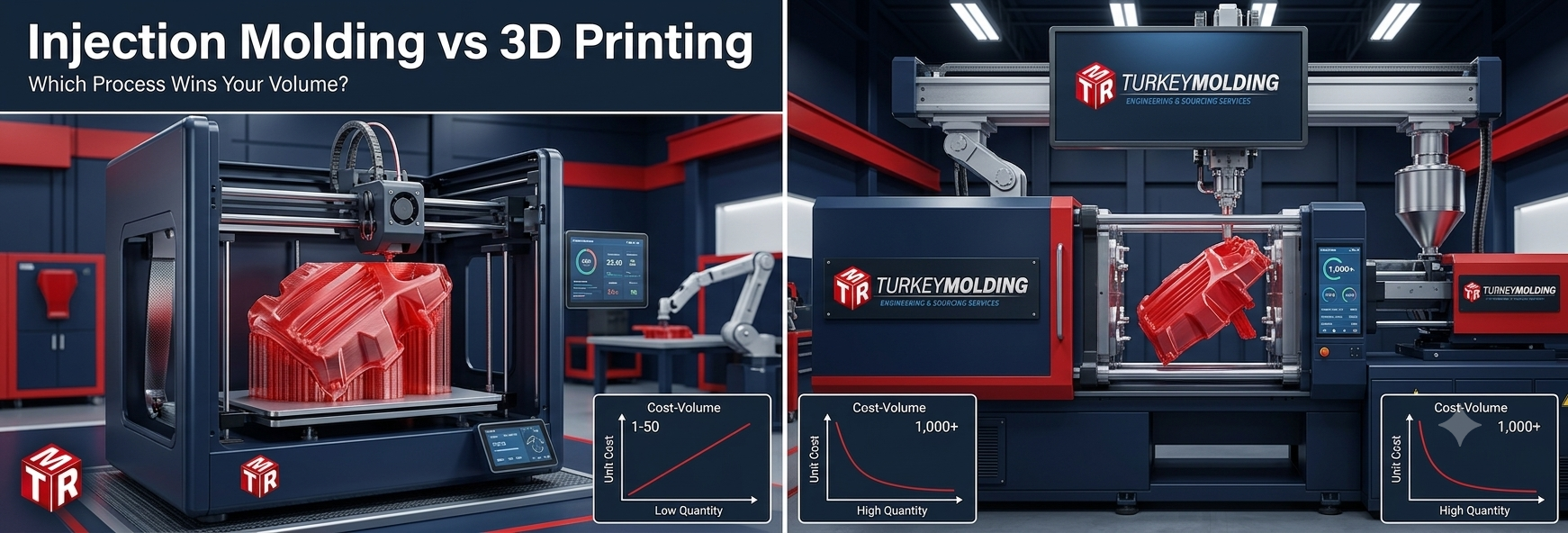
The financial comparison between these two methods depends almost entirely on your target batch quantity. Below is an overview of how your total manufacturing budget aligns across volume tiers:
| Production Quantity | 3D Printing (Additive) | Injection Molding (Subtractive) |
|---|---|---|
| 1 – 10 pcs | Best Option (Lowest total cost, no tooling risk) | Highly Expensive (Amortizing tooling over 10 parts is prohibitive) |
| 10 – 100 pcs | Good Option (Highly economical for test groups) | Moderate (Accessible if using low-cost prototype aluminum tooling) |
| 100 – 1,000 pcs | Expensive (Machine time and high material costs add up) | Better (Unit cost reductions begin to balance tool amortization) |
| 1,000+ pcs | Exceptionally Expensive (Slower cycle speeds lead to massive backlogs) | Best Option (The absolute industry standard for rock-bottom unit costs) |
Tooling & Structural Scalability Metrics
Understanding your upfront financial risk versus your long-term manufacturing scalability is essential for proper budgeting:
| Evaluation Factor | 3D Printing | Injection Molding |
|---|---|---|
| Initial Tooling Cost | None ($0 upfront investment) | Required (Ranging from $1,500 to $50,000+ based on complexity) |
| Variable Cost Per Piece | High (Stays flat regardless of volume) | Extremely Low (Drops drastically as raw material volume scales) |
| Scalability Horizon | Limited (Linear time scaling: 10,000 parts takes 10,000x longer) | Excellent (Exponential output scaling via multi-cavity automation) |
Production Lead Time Breakdown
Time-to-market constraints can dictate your manufacturing choice. The operational lead times differ widely due to the tooling setup phase:
- 3D Printing: 1 – 5 Days. Production begins almost immediately. The digital file is sent to the printer slice-engine, the bed is preheated, and execution occurs autonomously.
- Injection Molding: 2 – 8 Weeks. The lead time includes designing the tool, running mold-flow simulations, CNC machining the core and cavity blocks, polishing the steel, and calibrating the injection press variables during initial T1 trials.
Part Quality & Material Performance Comparison
Beyond economics, the physical and mechanical performance of the final component must meet your strict structural requirements:
Injection Molding
- ✓ Superior Surface Finish: Delivers glassy, textured, or mirror-polished surfaces right out of the mold, matching retail consumer expectations.
- ✓ High Isotropic Strength: Molten plastic cools as a continuous, dense mass, providing uniform mechanical properties in all direction vectors ($X, Y,$ and $Z$).
- ✓ Exceptional Repeatability: Tolerances are maintained consistently over hundreds of thousands of parts.
- ✓ Extensive Resin Catalog: Supports thousands of commercial grade polymers, including glass-filled nylon, high-impact polycarbonate, and elastomeric materials.
3D Printing
- ✓ Fast Iterative Agility: Modify a feature in CAD and print a revised physical part the next day without scrapping physical tooling.
- ✓ Complex Internal Architecture: Easily handles internal cooling channels or custom lightweight lattices.
- ✓ Anisotropic Vulnerability: Parts built via layering are anisotropic, meaning they are structurally weaker along the $Z$-axis layer-lines, which can lead to delamination under heavy structural loads.
Strategic Sourcing Decision Framework
To easily guide your engineering procurement pipeline, use this operational checklist:
Deploy 3D Printing When:
- ✓ You are in the initial phase of concept validation or investor presentation.
- ✓ You need functional testing prototypes to check mechanical clearances.
- ✓ Your total production volume stays below a few hundred total parts.
- ✓ The geometry features complex internal pathways that traditional tooling cannot mold.
Deploy Injection Molding When:
- ✓ You are transitioning into formal commercial or retail sales.
- ✓ Your production forecast exceeds 1,000 pieces over the product life cycle.
- ✓ The end product requires a premium surface finish or structural strength.
- ✓ You are manufacturing standard consumer goods that face fierce price competition.
Sourcing Break-Even Analysis
The intersection point where injection molding becomes more economical than 3D printing is called the Tooling Break-Even Point.
Cost Modeling Scenario
Consider a standard electronics plastic enclosure:
- 3D Printing Cost: Flat $20 per part (no tooling investment).
- Injection Molding Cost: $2 per part, but requires a $4,500 aluminum mold.
To find the inflection point where the initial tooling cost balances out the higher per-part cost of printing, we apply a standard break-even formula:
$$\text{Break-Even Quantity} = \frac{\text{Tooling Cost}}{\text{3D Print Unit Cost} - \text{Injection Mold Unit Cost}}$$
$$\text{Break-Even Quantity} = \frac{\$4,500}{\$20 - \$2} = 250 \text{ units}$$
- Below 250 Units: 3D printing is more economical because you save the $4,500 upfront tooling budget.
- Above 250 Units: Injection molding yields a higher return on investment. At 5,000 units, 3D printing would cost $100,000, whereas injection molding costs only $14,500 total (tooling + production), saving you $85,500.
The Hybrid Manufacturing Strategy
Top product teams rarely choose one technology exclusively; instead, they deploy a hybrid manufacturing model that combines the strengths of both to reduce risk and cut overall development time:
[Phase 1: 3D Printing]   -->  [Phase 2: Mold Optimization] -->  [Phase 3: Injection Molding]
Functional Prototyping         DFM & Simulation Trials          Mass Production Launch
1. 3D Printing (Prototyping & Beta Testing)
Utilize high-resolution 3D printing to iterate through early design phases, test fit components, and distribute field-test units to gather real-world user feedback.
2. Design for Manufacturability (DFM) Review
Once the product design is locked in, transition the 3D CAD models into a professional DFM evaluation. This step optimizes draft angles, wall thicknesses, and parting lines to ensure the part can be cleanly ejected from a metal tool.
3. Injection Molding (Scale Production)
Commit your budget to a high-precision aluminum or steel tool to lower your per-part cost, ramp up production speeds, and deliver retail-ready products globally.
How TurkeyMolding Streamlines Your Production Lifecycle
Navigating international manufacturing pipelines demands strong engineering support, clear communication, and reliable quality assurance. TurkeyMolding acts as your single technical point of contact across Turkey's elite production network:
- Vetted Additive & Subtractive Networks: We connect your project with thoroughly audited, ISO-certified industrial 3D printing hubs and world-class injection molding toolrooms under one unified umbrella.
- Rigorous Pre-Tooling DFM Analysis: Our application engineers cross-reference your 3D printed prototypes against molding constraints, catching potential flaws (like sink marks or trapped air pockets) before you invest in tooling.
- Transparent Tooling & Part Estimations: Get completely itemized quotes breaking down rapid additive prototyping costs, metal mold alloy selections, and final shot unit costs.
- End-to-End Operational Oversight: We oversee the entire technical pipeline—from initial functional prototype iterations to T1 sample approvals and final high-volume packaging delivery—ensuring your timeline stays on track.
Request Your Manufacturing Quote
Ready to optimize your product's unit economics, minimize tooling risks, and leverage Turkey's premier manufacturing ecosystem? Let TurkeyMolding manage the heavy lifting.
Contact our engineering sourcing team today to upload your 3D CAD files (STEP, IGES, or X_T). We will deliver a comprehensive manufacturability analysis alongside a competitive, transparent 3D printing or injection molding quote.
[Get a Free Manufacturing Quote Now]