Prototype Manufacturing in Turkey | CNC, 3D Printing & Injection Molding
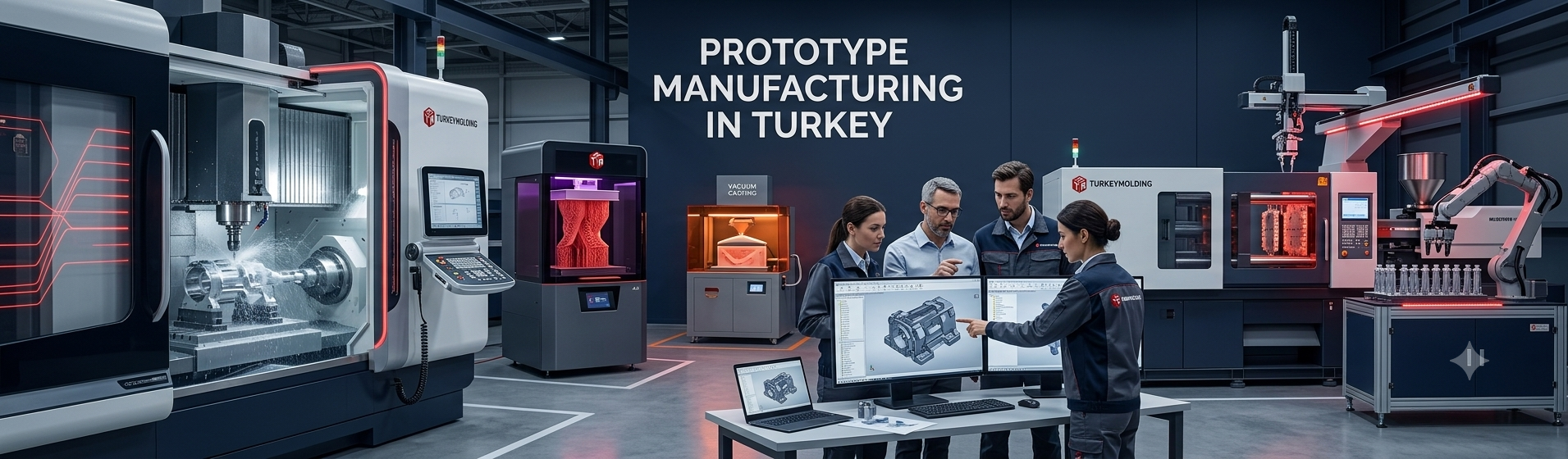
Prototype Manufacturing in Turkey | CNC, 3D Printing & Injection Molding
Bringing a new hardware product, consumer electronic device, or industrial component to market requires a seamless transition from a digital design to a physical object. For startup founders, product developers, industrial designers, and R&D teams, prototype manufacturing is the most critical phase of the product development lifecycle. It bridges the gap between conceptual engineering and automated mass production.
Choosing Turkey as your manufacturing hub for rapid prototyping allows you to combine elite engineering talent, advanced subtractive and additive technologies, and strategic geographical logistics. This 2026 comprehensive guide breaks down the core prototyping methodologies, lead times, cost matrices, and development steps to scale your product from a single functional sample to millions of units.
What Is Prototype Manufacturing?
Prototype manufacturing is the fabrication of early-stage, functional, or visual representations of a product before committing to expensive high-volume production tooling. Rather than risking capital on unverified designs, rapid prototyping allows engineering teams to physically test parts, find design flaws, and validate manufacturing setups early on.
Core Purposes of Prototyping
- Design & Aesthetic Verification: Assessing the physical proportions, industrial design ergonomics, and visual look of the product in real-world environments.
- Functional & Mechanical Testing: Evaluating structural integrity, snap-fits, screw thread strengths, and physical clearances under realistic mechanical stresses.
- Customer & Market Presentation: Shipping high-fidelity physical samples to early beta testers, focus groups, or major distribution partners to collect real-world feedback.
- Investor Presentation & Crowdfunding: Presenting high-quality, operational prototypes to venture capitalists or showcasing them in Kickstarter/Indiegogo campaigns to secure capital.
- Pre-Production Tooling Validation: Running initial tests on design geometry to check for mold-flow performance, shrinkage, and assembly tolerances before cutting permanent high-volume steel tooling.
Prototype Manufacturing Methods
No single prototyping method fits every design or stage of development. Top hardware engineering teams select different technologies based on material requirements, tolerance targets, and sample quantities:
1. CNC Prototyping
Subtractive CNC machining carves blocks of raw engineering polymers or metal billets into finalized components using high-speed automated milling and turning cutters.
- ✓ Core Strengths: Works with final production metals (aluminum, stainless steel, brass) and engineering plastics (Delrin, POM, PEEK, Nylon).
- ✓ High Precision: Easily holds strict industrial tolerances down to $\pm0.01\text{ mm}$.
- ✓ Functional Validation: Ideal for load-bearing structural parts, engine brackets, and fluid manifolds requiring real mechanical properties.
2. 3D Printing (Additive Prototyping)
Industrial additive manufacturing builds complex physical geometries layer-by-layer directly from your digital CAD files, completely bypassing the need for physical molds or fixture tooling.
- ✓ Unmatched Turnaround Speed: The fastest way to turn a 3D digital concept into a physical part.
- ✓ Minimal Upfront Costs: Perfect for one-off iterations without any financial penalties for setup changes.
- ✓ Design Freedom: Creates complex internal lattices and undercut features that are impossible to machine with traditional cutters.
3. Vacuum Casting (Polyurethane Casting)
Vacuum casting bridges the gap between additive prototyping and injection molding. A 3D printed master pattern is encased in liquid silicone to create a flexible mold. Polyurethane resins are then injected into the silicone mold cavity under a vacuum.
- ✓ Small Batch Run Efficiency: Highly economical for producing high-fidelity pre-production batches of 10 to 100 parts.
- ✓ True Elastomeric Properties: Ideal for prototyping rubber gaskets, over-molded handles, and flexible silicone-like buttons.
- ✓ Low Upfront Tooling Risk: Silicone molds are fast and inexpensive to pour compared to metal tooling.
4. Prototype Injection Molding (Rapid Tooling)
Rapid tooling uses standardized mold bases and quick-turn aluminum or pre-hardened steel blocks to inject final production-grade plastics under full pressure.
- ✓ Production-Grade Quality: Yields identical material density, cosmetic surface finishes, and structural properties to final mass production parts.
- ✓ Bridge Production Runs: Delivers low-volume batches (500 to 5,000+ units) to clear regulatory certifications or start early sales while permanent high-volume multi-cavity tools are being machined.
5. Sheet Metal Prototyping
Designed specifically for enclosures, structural brackets, and flat chassis assemblies.
- Laser Cutting: Rapidly profiles sheet metal outlines with high-precision fiber optics.
- CNC Bending: Utilizes automated press brakes to create crisp, repeatable structural bends and corners.
- Welding & Assembly: Fastening joints via TIG/MIG welding, pem-nut insertions, and rivet assemblies to yield durable, end-use metallic enclosures.
Prototype Manufacturing Timelines
Time-to-market can make or break a product launch. Sourcing your rapid prototypes through Turkey's ecosystem cuts down design iteration loops significantly:
| Prototyping Process | Typical Production Lead Time | Best Suited For |
|---|---|---|
| Industrial 3D Printing | 1 – 3 Days | Visual mockups, fast form verification, and quick fit checks. |
| CNC Machining Services | 3 – 7 Days | Precision structural parts and end-use metal assemblies. |
| Vacuum Casting (Silicone Molds) | 5 – 10 Days | Short-run cosmetic display samples and soft elastomeric parts. |
| Prototype Mold (Rapid Tooling) | 2 – 5 Weeks | Full functional testing, certification runs, and early sales batches. |
Cost Curve Comparison Matrix
Evaluating the financial and operational trade-offs of each method helps you allocate your development budget efficiently across different stages of your pipeline:
| Manufacturing Method | Upfront Initial Tooling Cost | Variable Unit Cost | Material Integrity Score |
|---|---|---|---|
| 3D Printing (Additive) | Very Low ($0 Setup Fees) | High (Machine time scales linearly) | Medium (Layer lines affect mechanical strength) |
| CNC Prototype Machining | Low (Only minor fixture setups) | Medium (Based on material waste & cycle hours) | Excellent (Carved from dense, extruded billet stock) |
| Vacuum Casting | Medium (Affordable silicone molds) | Medium (Polyurethane chemical resins) | High (Simulates various structural polymers well) |
| Prototype Injection Mold | High (Upfront metal tool cutting) | Very Low (Pennies per injected part at scale) | Maximum (Uses official industrial engineering resins) |
The Standardized Prototype Development Process
To move your product systematically from an abstract idea to scalable global distribution, TurkeyMolding relies on a structured, seven-stage engineering pipeline:
[Step 1: CAD Design] ➔ [Step 2: DFM Review] ➔ [Step 3: Process Selection] ➔ [Step 4: Manufacturing]
                                                                                   │
[Step 7: Mass Production] ⮘ [Step 6: Design Revision] ⮘ [Step 5: Physical Testing] ⮘┘
- Step 1: CAD Design Initialization: Your engineering team exports the final mechanical concept into standardized 3D digital file formats (STEP, IGES, or Parasolid $X\_T$).
- Step 2: Design for Manufacturability (DFM) Review: TurkeyMolding’s application specialists analyze the geometry. We look for potential issues like uniform wall thicknesses, draft angles, sharp internal radii, and deep pockets before any metal is cut or resin is cured.
- Step 3: Prototype Method Selection: We pair your current development goals (speed, precision, mechanical strength, or volume) with the optimal manufacturing setup.
- Step 4: Execution & Manufacturing: The verified file moves to our manufacturing network, where it is routed to high-speed CNC lines, industrial additive printing beds, or rapid tool rooms.
- Step 5: Physical Testing Loops: Your engineering team performs stress tests, inspects dimensional tolerances, validates snap-fits, and runs environmental safety trials on the raw prototypes.
- Step 6: Digital Design Revision: Any interferences, material failures, or assembly stack-up issues found during physical testing are corrected in the digital CAD model.
- Step 7: Mass Production Launch: Once the design passes all functional validation milestones, TurkeyMolding seamlessly transitions your project into high-volume die casting, plastic injection molding, or full-scale stamping lines.
Strategic Selection Framework
To find the right rapid prototyping approach for your current engineering cycle, use this simple decision matrix:
- If your primary constraint is turnaround speed: Choose 3D Printing. It is the ideal path to check basic hand-held scale, verify mating features, and execute rapid, low-cost visual design updates within hours.
- If your primary requirement is precision or metal materials: Choose CNC Machining. This approach delivers tight tolerances ($\pm0.01\text{ mm}$) and uses high-strength blocks of real aluminum, steel, or brass.
- If your target is a low-volume test run (10-100 parts): Choose Vacuum Casting. This allows you to rapidly build high-fidelity pre-production units with complex finishes and real elastomeric properties without investing in metal tools.
- If you need retail-ready parts for end-use testing: Choose Prototype Injection Molding. This process uses quick-turn aluminum molds to run genuine engineering plastics, providing true mechanical testing data and retail-quality finishes before mass-producing.
Target Industries We Serve
Turkey’s manufacturing hubs handle complex, highly regulated prototype development projects across diverse global industries:
- Automotive Sourcing: Precision interior panels, custom lighting enclosures, functional intake manifolds, and high-strength metal brackets.
- Medical Devices: Biocompatible device enclosures, surgical handling models, fluidic ports, and internal mechanical assemblies.
- Aerospace & Defence: High-tolerance CNC-machined structural aircraft parts, lightweight drone brackets, and rugged electronics housings.
- Consumer Electronics & Products: High-gloss enclosures, snap-fit wireless router housings, handheld power tools, and custom smart home appliances.
- Advanced Agriculture: Smart greenhouse components, IoT sensor housings, irrigation flow controls, and custom robotic actuator housings.
- Industrial Equipment: Heavy machinery gears, robust distribution manifolds, safety valves, and structural cast frames.
Why Source Your Prototypes in Turkey?
Turkey has grown into a premier hub for hardware startups and multinational OEM procurement managers looking for fast, high-quality prototyping solutions:
- Deep Technical Engineering Talent: Highly skilled industrial design and mechanical engineering teams can process complex files, optimize designs for manufacturing, and handle strict tolerance demands.
- Highly Competitive Pricing: Lower labor and operational overhead costs allow you to run more design iterations within budget compared to Western European or North American toolrooms.
- Fast Logistics Networks to Europe: Located at the crossroads of Europe, Asia, and the Middle East, Turkey offers fast shipping turnarounds via daily air freight or direct road freight networks.
- Modern Advanced Manufacturing Infrastructure: Turkish shops utilize top-tier multi-axis CNC machines, advanced industrial 3D printing equipment, and automated quality control setups.
- Vetted, Experienced Prototype Specialists: Local manufacturers are deeply integrated into global supply chains, ensuring strict adherence to western quality metrics, material certifications, and non-disclosure privacy agreements.
How TurkeyMolding Streamlines Your Prototyping Project
Sourcing rapid prototypes through multiple overseas vendors can lead to communication gaps, fluctuating lead times, and inconsistent part quality. TurkeyMolding acts as your unified technical partner on the ground, handling everything from early concept validation to mass production:
- Secure CAD Upload & Direct Analysis: Simply upload your STEP or IGES digital models to our secure engineering hub.
- Instant DFM & Method Optimization: Our application specialists analyze your design files to match your project's volume and tolerance targets with the best production process.
- Fast Quotes from Audited Facilities: Receive clear, itemized quotes from thoroughly verified, ISO-certified Turkish prototyping shops.
- End-to-End Project Tracking: We manage the entire manufacturing timeline—from material verification and multi-axis cutting to final dimensional inspections—keeping your launch on schedule.
- Seamless Scalability: Once your functional prototype is validated, we easily transition your project to production-grade aluminum or hardened steel tooling for permanent high-volume manufacturing.
Frequently Asked Questions
What is the fastest prototyping method?
Industrial 3D printing is the fastest method. Because it prints parts layer-by-layer directly from digital CAD files without requiring custom fixtures or tooling, high-fidelity components can be completed and shipped within 24 to 72 hours.
How much does a custom prototype cost?
Prototyping costs depend entirely on part size, geometrical complexity, chosen material, and required tolerances. A simple 3D printed visual mockup can cost under $50, whereas a complex 5-axis CNC-machined aerospace alloy fitting or a rapid prototype injection mold can range from several hundred to thousands of dollars.
Should I use CNC machining or 3D printing?
Choose 3D printing if you need fast design iterations, low upfront costs, and are validating visual form or fit. Choose CNC machining if you require real engineering metals or dense plastics, ultra-tight dimensional tolerances ($\pm0.01\text{ mm}$), or parts that will undergo high mechanical or thermal stress testing.
When should I invest in hard production tooling?
You should invest in permanent metal tooling only after your functional prototypes have successfully passed all real-world mechanical testing, fit clearance checks, and regulatory field certifications. If your design is still evolving based on user testing, stick to rapid 3D printing, CNC runs, or temporary aluminum molds to avoid expensive tool rework fees.
How long does prototype manufacturing take in Turkey?
Turnaround times are highly competitive: 3D printed parts are finished in 1–3 days, CNC components take 3–7 days, and complex rapid injection molds take 2–5 weeks to cut, sample, and ship to your facility.
Ready to Build Your Prototype?
Don't let engineering delays slow down your product launch. Leverage Turkey's premier prototyping infrastructure and advanced manufacturing network through TurkeyMolding.
Upload your 3D CAD files today to receive a comprehensive Design for Manufacturability (DFM) review and a transparent, competitive quotation from verified Turkish manufacturers.
[Get Your Free Prototyping Quote Now]